Blog · Compliance
Simpler Recycling for Businesses: What the Rules Mean in West London and the Thames Valley

Frazer Lanagan, Managing Director · 30 June 2026 · 5 min read
The short version
- Most businesses must separate dry recyclables, food waste, and general (residual) waste, with glass within the dry stream where collected separately.
- It applies to workplaces of essentially all sizes, with the lightest touch for very small premises.
- You do not always need a bin per material. Dry recyclables can often be collected together, simplifying your bin area.
- Compliance is mostly about the right bins, clear labelling, and keeping your waste transfer documentation.
Simpler Recycling is the framework that standardised how workplaces in England separate their waste. The name is the goal: fewer confusing local variations, a consistent set of streams everywhere. For a business owner the practical question is simple, what do I actually have to separate, and how do I do it without turning the bin area into chaos. Here is the plain version.
Not legal advice
This is a practical overview for busy operators, not formal legal guidance. Your exact obligations depend on your premises and waste. We will assess your site and set you up correctly, which is the part that actually keeps you compliant.
What you have to separate
Under Simpler Recycling, workplaces are expected to separate their waste into core streams rather than throwing everything into one general bin:
- Dry recyclables: paper and card, plastic, and metal. These can often be collected together in one dry mixed recycling bin.
- Glass: recycled within the dry recyclables, and frequently given its own container where volumes justify it, such as in hospitality.
- Food waste: collected separately from general waste, which matters most for kitchens, canteens and hospitality.
- General (residual) waste: what is genuinely left once the above are pulled out.
The headline change for many businesses is food waste. If your premises generates food waste, it needs its own collection rather than going in with general waste. For offices the bigger shift is usually making sure paper, card and packaging actually go into recycling rather than the general bin.
Who it applies to
The rules apply across workplaces of essentially all sizes, with the lightest requirements for the very smallest premises. In practice, if you run a commercial site, an office, shop, restaurant, warehouse or industrial unit, you are expected to separate your recyclables and food waste. The simplest way to know exactly where you stand is a quick site assessment, which is something we handle as part of setting up your collections.
How to comply without drowning in bins
The fear is a yard full of colour-coded bins and a folder of paperwork. It rarely needs to be that complicated. Three things get most businesses compliant and keep it that way.
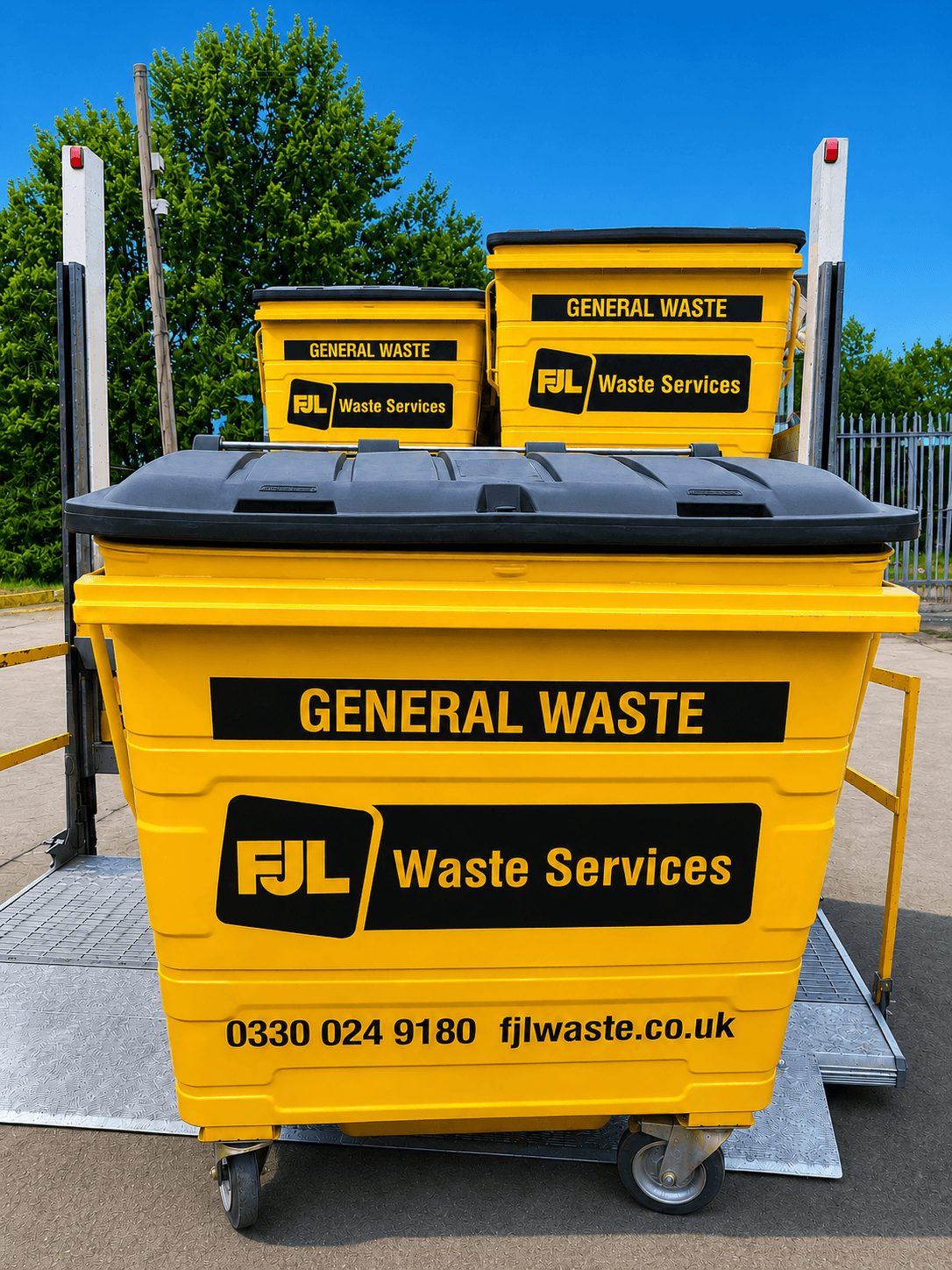
- 1Right bins, right sizes. One dry mixed recycling bin, a food caddy or food bin if you produce food waste, and a general waste bin sized to what is genuinely left. Glass gets its own container where volumes need it.
- 2Clear labelling and a quick staff brief. Most contamination comes from people not knowing which bin to use. Good labels fix most of it.
- 3Keep your paperwork. Every collection should generate a waste transfer note. Keep them on file so you can show compliance if asked.
Done well, separating streams often shrinks your most expensive bin, the general waste one, because clean cardboard and food waste are no longer filling it. Our Simpler Recycling service is built around this, and our business waste collection page covers the full set of streams. If you want to compare container options first, the commercial bins page lays them out.
Where FJL fits
We set businesses across West London, Surrey and the Thames Valley up for Simpler Recycling without the theatre. We do the site assessment, recommend the streams and bin sizes that fit your premises, handle the waste transfer documentation, and run a 100% landfill diversion service. We are fully licensed under waste carrier licence CBDU91900. Compliance becomes something that just happens in the background, which is how it should be.
The bottom line
Simpler Recycling means separating dry recyclables, food waste and general waste, with glass handled where volumes need it. For most businesses that is a handful of well-sized bins, clear labels, and kept paperwork, not a logistical headache. If you want it set up properly for your site, get a quote and we will assess what you need.
Frequently asked questions
What does Simpler Recycling require businesses to separate?
Dry recyclables (paper, card, plastic, metal), food waste, and general residual waste, with glass recycled within the dry stream and often given its own container where volumes justify it.
Does my small business have to comply with Simpler Recycling?
The rules apply to workplaces of essentially all sizes, with the lightest requirements for the very smallest premises. If you run a commercial site, you are expected to separate recyclables and food waste. A quick site assessment confirms exactly what you need.
Do I need a separate bin for every material?
Not usually. Dry recyclables such as paper, card, plastic and metal can often be collected together in one bin, which keeps your bin area manageable. Food waste is collected separately, and glass gets its own container where volumes need it.
How do I prove my business is recycling compliantly?
Keep the waste transfer notes generated by each collection. They document where your waste goes and are what you show if compliance is queried. FJL provides this documentation as standard.
Can separating recycling actually save money?
Often yes. Pulling clean cardboard and food waste out of general waste shrinks your most expensive bin, so right-sized recycling can reduce your overall cost.
Frazer Lanagan
Managing Director, FJL Waste Services
Frazer has 20 years in the waste and recycling industry, including time with large national operators, before starting FJL Waste 13 years ago.
More about Frazer Lanagan→