Blog · Bins & containers
Commercial Wheelie Bin Sizes Explained: 240L, 360L, 660L and 1100L

Frazer Lanagan, Managing Director · 30 June 2026 · 6 min read
The short version
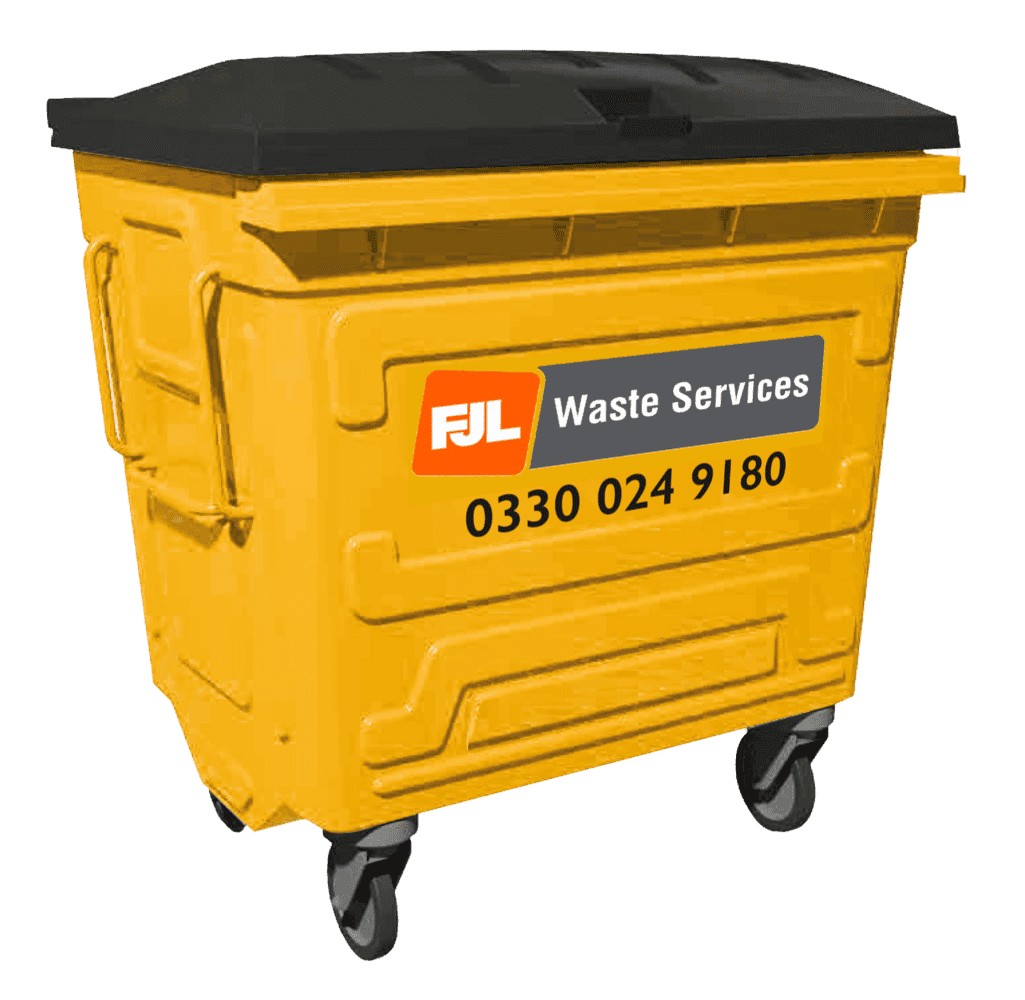
- A 240L bin holds roughly 3 to 4 standard bin bags, 360L around 5 to 6, 660L around 10 to 12, and 1100L around 18 to 20.
- Most small offices and shops run a 240L or 360L; busy restaurants, warehouses and mixed sites usually need 660L or 1100L.
- Right-sizing matters more than picking the biggest bin. A half-empty 1100L collected weekly costs more than a full 660L, for the same waste.
- You can mix sizes and streams. A common commercial setup is one general waste bin plus a separate recycling bin sized to whatever you produce most of.
Picking a commercial bin sounds simple until you are staring at four sizes and a price list. Choose too small and you get overflowing bins, missed bags and angry staff. Choose too big and you pay every week to lift a bin that is half air. This guide breaks down the four standard commercial wheelie bin sizes, what each genuinely holds, and the kind of premises each one fits, so you can size yours properly the first time.
Everything below is for business waste, not household collections. If you run a site anywhere across West London, Surrey or the Thames Valley, the same sizing logic applies whether you are a cafe in Twickenham or a warehouse in Slough.
The four standard commercial wheelie bin sizes
Commercial wheelie bins come in a handful of standard capacities. The two smaller sizes are two-wheeled bins you can move like a domestic bin. The two larger sizes are four-wheeled and stay in a bin store or yard. Here is the quick version, then the detail.
240 litre, the small two-wheeler
The 240L holds roughly 3 to 4 bin bags. It is the same footprint as a large domestic bin, so it tucks into tight spaces and rolls out easily. It suits small offices, salons, takeaways with low volumes, and any premises where space is tight or waste is light. If you are filling a 240L to bursting every collection, that is your sign to move up a size rather than add a second bin.
360 litre, the bigger two-wheeler
The 360L holds around 5 to 6 bin bags and is still a two-wheeled bin, so it stays easy to manoeuvre through standard gates and doorways. It is the natural step up for a growing office, a busier shop, or a small restaurant that has outgrown a 240L but does not have room for a four-wheeler. It is often the sweet spot for premises with limited access.
660 litre, the workhorse four-wheeler
The 660L is a four-wheeled bin holding roughly 10 to 12 bin bags. This is the workhorse of commercial waste. It suits mid-size restaurants, larger offices, blocks, and any site producing steady weekly volume. Because it is on four wheels it stays put in a bin store, and the lid clears comfortably under most canopy heights.
1100 litre, the high-capacity four-wheeler
The 1100L is the largest standard wheelie bin, holding around 18 to 20 bin bags. It is the most popular bin for busy commercial sites: restaurants, warehouses, retail parks and mixed-use premises with serious throughput. One 1100L often replaces a cluster of smaller bins and tidies up the whole bin area in the process.
Rule of thumb
If your bin is always full and you are stacking bags beside it, go up a size. If it is rarely more than half full at collection, you are paying for air and should either drop a size or stretch the collection frequency.
How to size your bin: volume times frequency
The number that actually matters is not the bin size on its own, it is bin size multiplied by how often it is emptied. A 660L lifted twice a week shifts more waste than an 1100L lifted weekly. So the smart approach is to estimate how many bags you fill in a normal week, then choose the combination of size and frequency that clears it without leaving the bin overflowing or half empty.
- 1Count the bags. Tally how many full bin bags your site produces in a typical week.
- 2Match the capacity. Use the bag figures above to find the bin that holds roughly that much per collection.
- 3Set the frequency. Weekly suits most sites. High-volume kitchens and busy retail often go twice weekly or daily.
- 4Split the streams. Move recycling and food waste out of general waste so your general bin can be smaller and cheaper.
That last point is where most businesses save money. Pulling cardboard, dry mixed recycling and food waste into their own bins shrinks the general waste bin you pay the most to handle. Our commercial bins and business waste collection pages cover the stream options, and you can see every container type, from caddies to compactors, on the bins and containers page.
Common setups by premises type
- Small office or shop: one 240L or 360L general waste, plus a 240L mixed recycling.
- Cafe or takeaway: a 360L or 660L general, a recycling bin, and a sealed food caddy for kitchen waste.
- Restaurant: a 660L or 1100L general, dry mixed recycling, glass, and separate food waste.
- Warehouse or industrial unit: one or more 1100L bins, often with cardboard handled separately or baled.
- Retail park or high-throughput site: multiple 1100L bins, or a compactor if volume justifies it.
None of these are fixed. The point of sizing properly is that your bins match your actual waste, not a guess. If you are not sure, the quickest route is to tell us your premises type and roughly what you throw away, and we will recommend the smallest setup that works, not the biggest one with the fattest margin.
The bottom line
Get the size and frequency right and your waste stops being a recurring headache. As a rough map: 240L and 360L for light and mid-volume small premises, 660L for steady commercial volume, 1100L for busy sites. Then split your streams so you are not paying general-waste rates to bin clean cardboard. If you want a second opinion on your current setup, get a quick quote and we will size it with you.
Frequently asked questions
How many bin bags fit in a 1100 litre commercial bin?
Roughly 18 to 20 standard bin bags, depending on how compacted they are. That makes the 1100L the go-to bin for busy restaurants, warehouses and retail sites with high weekly volume.
What is the most common commercial wheelie bin size?
The 1100 litre is the most popular for busy commercial sites because one bin replaces several smaller ones. For small offices and shops, the 240L and 360L are the most common choices.
Can I have different bin sizes for different waste streams?
Yes, and it usually saves money. A typical setup is a larger bin for general waste plus smaller bins sized to whatever recycling and food waste you produce, so you are not paying general-waste rates for clean recyclables.
Is it cheaper to have a bigger bin or more frequent collections?
It depends on your volume. A correctly sized bin emptied on the right frequency beats both an oversized bin lifted half empty and an undersized bin that overflows. We size the combination of capacity and frequency to your actual weekly volume.
Do you supply commercial bins across West London and the Thames Valley?
Yes. FJL supplies and collects commercial bins across West London, South West London, Surrey and the Thames Valley, from our depot in Uxbridge. Tell us your town and we will confirm the service.
Frazer Lanagan
Managing Director, FJL Waste Services
Frazer has 20 years in the waste and recycling industry, including time with large national operators, before starting FJL Waste 13 years ago.
More about Frazer Lanagan→